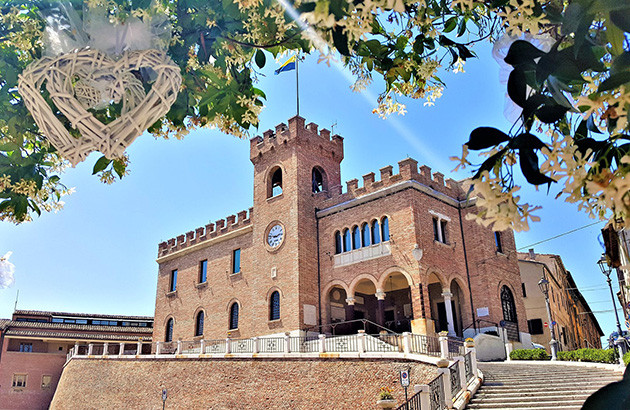
MONDOLFO
The historic hilltop village of Mondolfo, together with its coastal extension of Marotta, is a remarkable example of "two towns in one", where the traditions of the countryside and the sea come together in perfect harmony.
Encircled by impressive double medieval walls, Mondolfo has preserved an exceptional architectural and cultural heritage. Highlights include the magnificent Church of Sant’Agostino with its elegant cloister, the Romanesque Church of San Gervasio, whose crypt houses a precious Ravenna sarcophagus, and the Sanctuary of Madonna delle Grotte, nestled within a peaceful pine forest and connected to the ecological and cultural trail known as the Valle dei Tufi.
Overlooking the surrounding countryside along the fortified walls of Mondolfo Castle lies the Martinian Garden, created within the Bastion of Sant’Anna. This beautifully landscaped Italian-style garden offers a tranquil setting and breathtaking panoramic views across the rolling Marche hills.
MAROTTA
The waters of the Adriatic shimmer in every shade of blue, from deep gentian to brilliant turquoise, before fading into crystal-clear azure. Beyond the coastline, rolling hills stretch towards the horizon, their landscapes glowing with golden wheat fields, sunlit vineyards and endless open skies. These are the colours that define Mondolfo and Marotta and tell the story of a land shaped by both sea and countryside.
The municipality's blue and gold flag symbolises centuries of history. It recalls the ancient Castle of Mondolfo, established during the final years of the Roman Empire to guard the mouth of the Cesano River. This strategic stretch of coastline, between Senigallia and Fano, also marked the gateway to the inland valleys leading towards the majestic Monte Catria massif.
For centuries, Mondolfo's fortified walls protected a vibrant community of farmers, fishermen, landowners and soldiers. While local people cultivated the fertile countryside and harvested the riches of the Adriatic, guards kept watch along the coast at Marotta, defending the territory against Ottoman raids and overseeing the collection of tolls from travellers passing through the lands of the Dukes.