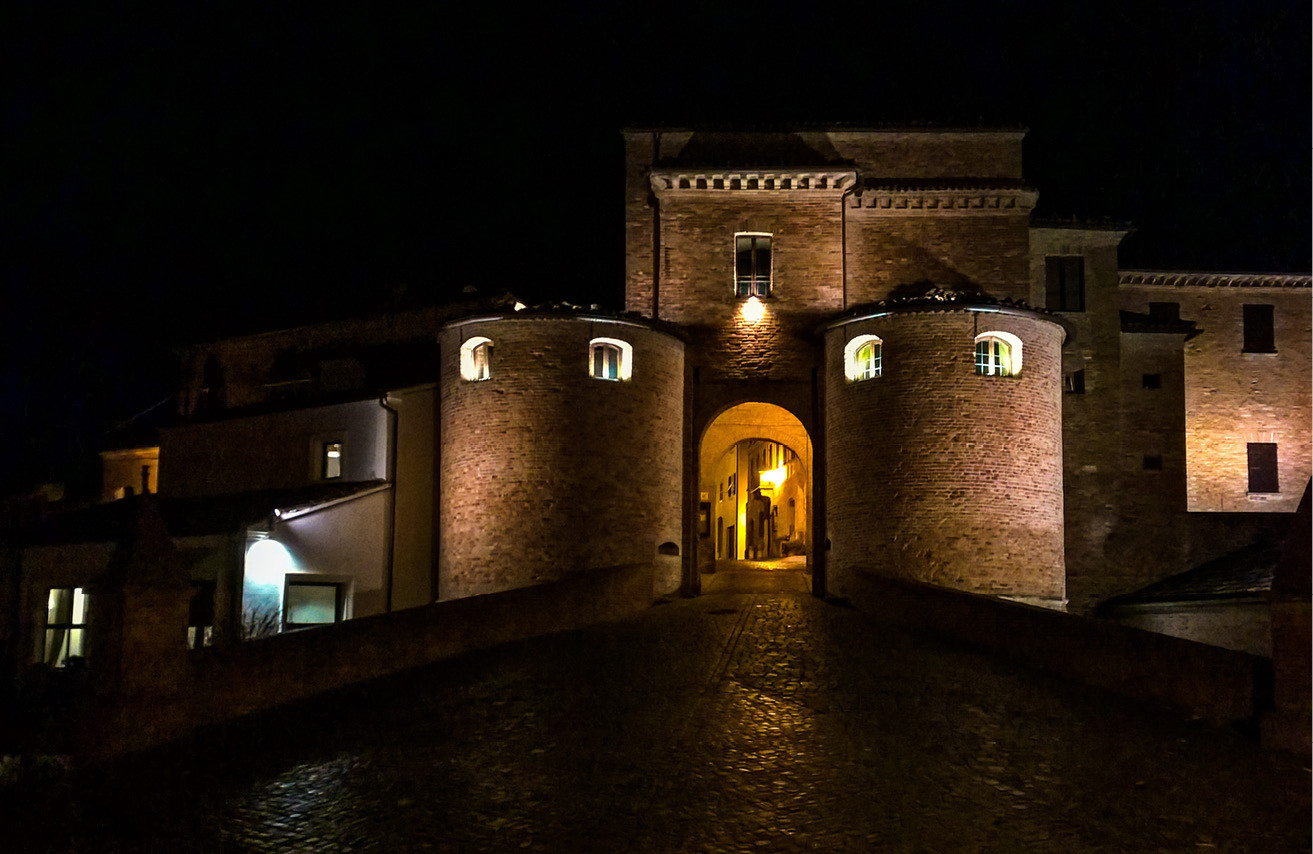
Mombaroccio stands on a hill just a few kilometres from Pesaro and still preserves the compact, fortified appearance of an ancient medieval village. The settlement follows a distinctive “herringbone” layout, with narrow lanes and buildings branching out from the main street, all enclosed within the old defensive walls.
Founded in the 13th century, the village was closely linked to the city of Pesaro and to the rule of the Malatesta family, during whose domination its urban structure took shape. The monumental Porta Maggiore also dates back to this period and remains one of the most evocative entrances to the historic centre, flanked by two imposing cylindrical towers. Later, the Sforza family strengthened the fortifications, adapting them to the new military techniques introduced with the arrival of firearms.
During the Renaissance, Mombaroccio experienced a flourishing cultural period thanks to the Marchesi del Monte family. Among the most important figures associated with the village was Guidubaldo del Monte, a mathematician and scientist close to Galileo Galilei and a fellow student of Torquato Tasso. Within the family palace, a space dedicated to scientific experiments carried out in collaboration with Galileo can still be visited today.
One of the most captivating features of Mombaroccio is the panorama visible from the village walls: views stretch from the Adriatic coast to the inland hills, reaching as far as Rimini, Ancona and the skyline of San Marino on clear days.
Among the most interesting places to visit are the Museum of Rural Civilisation, housed in the underground rooms of the former Girolomini Friars’ convent, the Museum of Sacred Art located in the sacristy of the Church of San Marco, and the Galleria della Torre, dedicated to the ancient tradition of embroidery.
Surrounded by the greenery of Monte della Mattera stands the evocative Convent of Beato Sante, a Franciscan complex founded in the 13th century and later redesigned during the 16th century by architect Girolamo Genga. Encircled by chestnut, oak and holm oak woods, the convent preserves a deep spiritual history linked to Blessed Sante Brancorsini and remains one of the most important spiritual sites in the region.
Over the centuries, the convent endured difficult periods, from the Napoleonic suppressions to the Second World War, when it provided refuge to hundreds of persecuted people, including many Jews fleeing Nazi deportations. Today, the complex houses significant works of art displayed in the Pinacoteca-Museum, including the Polyptych by Zanino di Pietro, the Madonna of Humility by Andrea di Bartolo and precious 15th-century paintings. Inside the church is also a magnificent 14th-century Crucifix attributed to the Master of the Bell Puig Coronation.