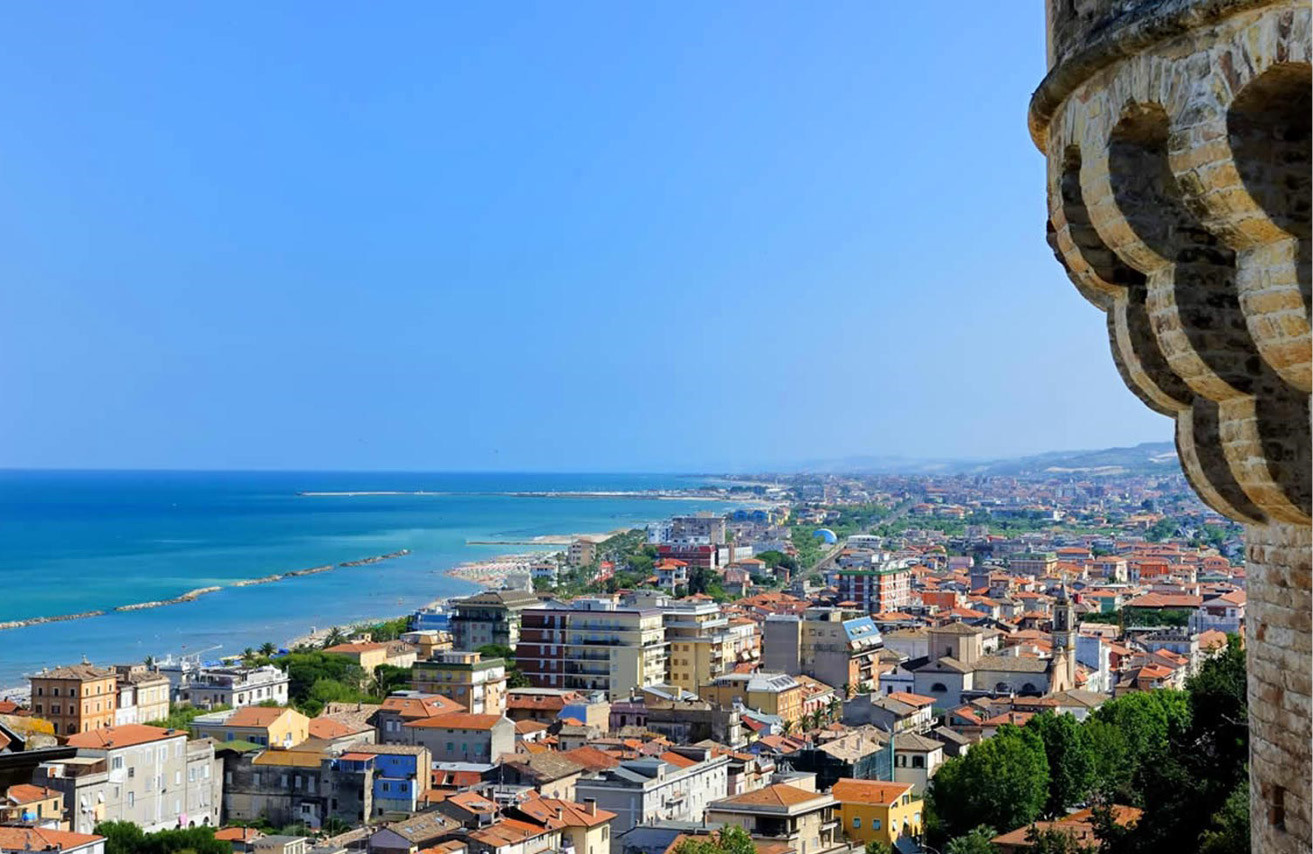
Grottammare, overlooking the Riviera delle Palme, is one of the most charming destinations along the Marche coastline. Long appreciated for its mild climate, elegant scenery and relaxed atmosphere, the town combines the beauty of the sea with the timeless character of its historic hilltop village. Careful preservation of the area, attention to urban quality and a strong connection to its historical and natural heritage have earned Grottammare several prestigious awards, including the Blue Flag, Legambiente’s Three Sails and inclusion of the Vecchio Incasato among The Most Beautiful Villages in Italy.
The seafront promenade, stretching for several kilometres along the coast, is one of the town’s defining features: a continuous line of palm trees, oleanders, orange trees and landscaped gardens that make every walk by the sea especially enjoyable. A cycle and pedestrian path runs along the entire waterfront, allowing visitors to experience the coastline away from traffic, between beach resorts, panoramic squares, fountains and terraces overlooking the shore. The southern stretch of the promenade is known for its scenic green spaces and relaxing atmosphere, while the recently redeveloped northern promenade offers beautiful views across the Adriatic Sea.
Among the town’s most beloved spots are the Pineta dei Bersaglieri, ideal for families and shaded moments of relaxation, Piazza Kursaal with its elegant travertine paving, and the charming Viale Marino, lined with early 20th-century Liberty-style villas and a long seaside cycle path running between the rocks and the sea towards the northernmost beach, still wide and wonderfully natural.
Overlooking the marina from above is the Vecchio Incasato, the medieval heart of Grottammare, carefully restored and today considered one of the town’s most atmospheric areas. Wandering through its narrow lanes, stairways and ancient walls reveals important historic landmarks such as the Church of Sant’Agostino and the Church of Santa Lucia, built on the site traditionally believed to be the birthplace of Pope Sixtus V.
At the centre of the old village lies Piazza Peretti, an elegant panoramic terrace with extraordinary views over the coastline. Here stand the Teatro dell’Arancio and the Church of San Giovanni Battista, home to the Museo Sistino. Among the town’s most important cultural sites is also the Torrione della Battaglia, a 16th-century defensive tower housing the museum dedicated to sculptor Pericle Fazzini, creator of the celebrated Resurrection sculpture in the Vatican’s Sala Nervi. Grottammare is also home to the Museo Il Tarpato, dedicated to artist Giacomo Pomili and his creative work.
The town remains lively throughout the year thanks to a rich cultural programme of performances, music, theatre, markets and events. During the summer months, Corso Mazzini comes alive with street performers, music and evening entertainment, while the historic village hosts concerts, cultural gatherings and events dedicated to poetry and classical music. Among the best-known events are “Cabaret Amore Mio!”, the Liszt Festival, the food and wine walk “Juttenizie” and the traditional Living Nativity Scene.
Grottammare has also been awarded the “Spiga Verde” recognition, confirming its commitment to environmental sustainability and the enhancement of the local area. The town represents a destination where sea, culture, nature and quality of life come together in an authentic and harmonious balance